Scrapr
My own productFinding decision-makers and their contact details on LinkedIn.
I built and launched Scrapr, then sold it for five figures about three months later. It was my first SaaS sale, at seventeen.
Sold in late 2025

Founder & independent researcherBased in the United Kingdom
I started coding at ten and sold my first SaaS at seventeen. Today, I build products for other founders through Standen.
Alongside the builds, I’m researching how systems learn to reuse code, and sharing what I learn through talks.
A selection from 10+ SaaS products shipped.
Finding decision-makers and their contact details on LinkedIn.
I built and launched Scrapr, then sold it for five figures about three months later. It was my first SaaS sale, at seventeen.
Sold in late 2025
Guest discovery, matching and booking for podcast hosts.
I built the first version in 21 days. Tom owns the code, and the product has a waitlist of around 500 people.
First version delivered in 21 days
Inventory and project requirements for hardware teams.
I built the iOS and web product so teams can see what’s in stock, where it is, and which project needs it.
Handed over in September 2026
Client feedback
“Huge credit to Tomas Jones for moving fast, keeping scope tight, and building properly from day one.”
Independent research in program synthesis
A system can learn reusable pieces of code from problems it has already solved. I’m investigating whether the libraries that make those past solutions shorter also help it find solutions to new problems.
Working manuscript · Unpublished
Cost resolution depends on search budget
The study asks how finely a compression score can distinguish useful code libraries, and how that changes with the amount of search available.
The experiments use Stitch library learning, DreamCoder program representations and unguided enumerative search in a LILO-derived setup. The compression objective is weighted rewritten-corpus syntax cost, rather than complete two-part minimum description length.
For string editing at 10,000 candidates, the lowest-cost library outperforms a uniform draw from the full construction pool. Within a 10% cost band, the libraries have nearly the same utility. For CLEVR, 10,000 candidates produces a ceiling; at 100 candidates, cost distinguishes libraries within 2–10% bands. The choice to highlight CLEVR at 100 candidates followed observation of that ceiling.
This is ongoing work in two domains, using libraries induced from supplied programs and search with recognition disabled. Most libraries in each pool were not individually tested; the paired comparison uses a uniform draw. These are findings from a working manuscript, not a claim of general performance across AI systems.
Sharing the work and what I’ve learned
I speak about building software, agentic AI, and the experience of launching and selling a first product.
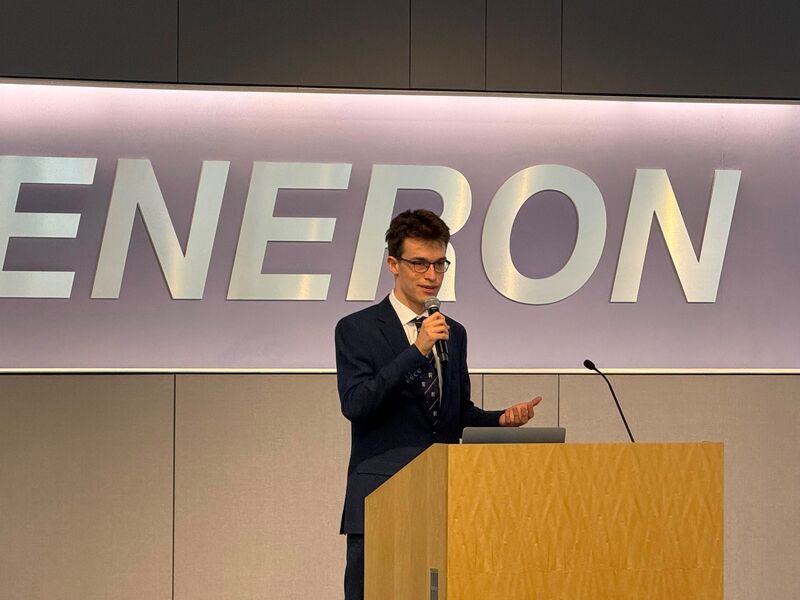
New York
Agentic AI, the sale of my first SaaS, and my work building software.
London
My background, the sale of Scrapr, and my independent research. Delivered in .
For a project, a conversation about the research, or a speaking invitation.
tomasjonesdev@gmail.com